|
 Mural Techniques Mural Techniques
Since the earliest parietal art in the caves of Lascaux,
murals are an important art form. Its techniques evolved in
Ancient Greece, then Rome, to reach its peak with the
frescos of 15th century Europe and 18th century Venice.
Murals can be painted on different types of walls, either
natural (rock) or man-made (stone, earth or brick
walls).
Murals are a key element in architecture and demand a high
level of skill in drawing and coloring techniques.
Technically, there are two types of murals: frescos (a
fresco), where the wall is painted before the plaster dries,
and dry painting (a secco), where a binding agent (oil, wax,
eggs, glue) is used to hold the paint on a dry wall.
For both techniques, the preparation of the wall involves
two successive layers: the arricio, that smooths the surface
to be painted, and the intonaco, that absorbs the colors.
|
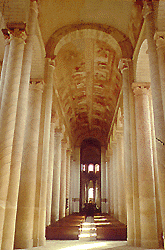
Saint-Savin Abbey, view of the nave
cliche©M.Deneyer/CIAM
|