|
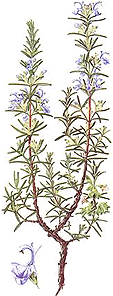
Rosemary is a gamopetalous plant of the Labiatae family,
and comes from the Mediterranean region. It needs warmth,
but can survive mild winters.
Its Latin name means "sea dew", and in the language of
flowers, rosemary represents memory. Rosemary was used only
for religious purposes in ancient times, then used as a
medicinal plant in the Middle Ages. Today, rosemary is used
as an aromatic plant and also in the manufacture of perfume
(oil is extracted from its leaves).
 At high doses, rosemary can provoke
dizziness and spasms. At high doses, rosemary can provoke
dizziness and spasms.
In the past, it was used in small doses in an ointment to
cure rheumatism.
In decoction it was used to clean infected wounds or wounds
that did not heal.
It was used in infusions for its diuretic properties.
The Queen of Hungary's
Waters
In the 17th century, a liqueur made from rosemary
flowers distilled and fermented in honey acquired an
unprecedented reputation in France. It was known as "the
Queen of Hungary's waters". Legend has it that this liqueur
miraculously cured the Queen of Hungary in the 13th
century.
It was mostly used as an eau de toilette in the 17th
century. All the "grandes dames", starting with Madame de
Sévigné, owned a flask of it. Used for
massage, it was said to cure rheumatism, and was even used
by Louis XIV himself.
|
|

